Investigating Rising Whale Deaths in the San Francisco Bay Area
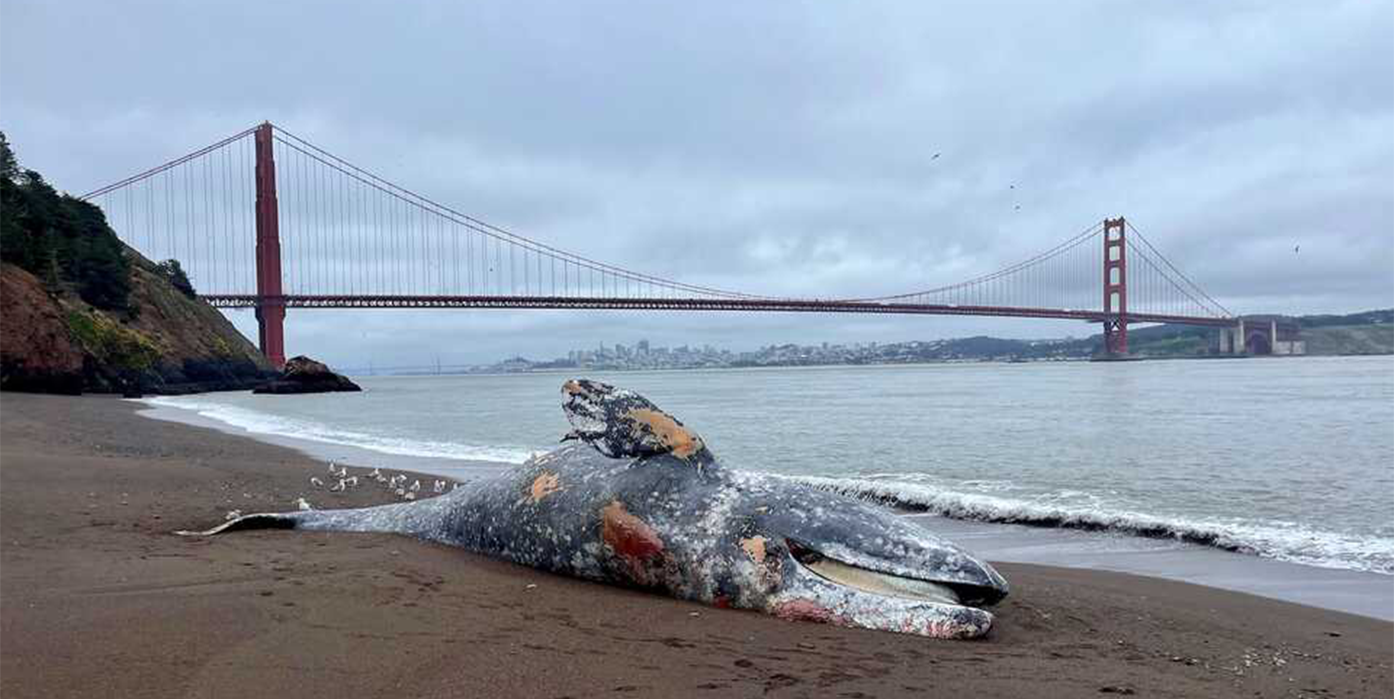
In 2025 alone, 18 whales have washed ashore—deceased, emaciated, and rapidly decomposing—along the coast of the San Francisco Bay Area. With rising temperatures in ocean waters depleting key food sources, whales are increasingly becoming stranded during their natural migration routes from Alaska to Baja California, Mexico. Starving and often pregnant, stranded whales wander into the Bay in search of sustenance, only to be fatally struck by the massive shipping vessels occupying the waters beneath the iconic Golden Gate Bridge.
Marine researchers and ecologists are overwhelmed with investigating and preventing these tragic deaths. When a whale washes ashore, a dedicated team of scientists perform a detailed necropsy to determine the cause of death. This arduous process is complicated by the advanced stages of decomposition that many of these whales are found in.
As a species, whales have long been the subject of both scientific interest and cultural fascination. From “Free Willy” (1993) to “Blackfish” (2013), modern media has shaped the global discourse around human impact on the whale’s existence, and attempted to humanize the suffering of these mystical giants. In a time of escalating climate crisis, the threats facing whales are deeply entangled with a wide range of urgent environmental issues—many of which feel too vast and overwhelming for any single person to solve overnight.
As the whales make their way south to give birth in the lagoons of Baja California, Mexico, they have become increasingly stranded and injured in the San Francisco Bay. The Bay, serving as a high traffic pathway for goliath-sized ships passing under the iconic Golden Gate bridge, has become a dangerous crash zone for stranded whales. As warming oceans decrease food availability, whales are driven away from their natural migration paths and into busy shipping areas such as The Bay, where they are more frequently struck and killed by vessels. In 2025 alone, 18 whales have washed ashore deceased from various causes. This spike in whale deaths comes not long after the previous Unknown Mortality Event (UME) classified by the California Academy of Sciences from 2019-2023, which saw a whale population loss of 45%.
The California Academy of Sciences, The Marine Mammal Center, and other organizations part of the NOAA’s West Coast Marine Mammal Stranding Network continue to work towards demystifying the primary causes behind the ongoing increase in whale deaths. Through field necropsies (comprehensive whale autopsies that require extensive fieldwork and funding), data collection, and government/community outreach, awareness has been raised and real change has been enacted. After analyzing over 700 whale stranding instances during the 2019-2023 UME, these organizations have determined the main contributing factors: deadly fishing gear entanglements, blunt force trauma from ship strikes, parasitic infections, and severe malnutrition. In light of this glaring issue, the NOAA propelled the “Protecting Blue Whales and Blue Skies”, which has impacted legislation around vessel speeds and paths under the iconic Golden Gate Bridge. AI-driven Whale Safe technology has been implemented in San Francisco to provide real-time data regarding whale movement patterns to shipping companies. Some of these shipping companies even receive incentives for compliance. Yet, the question remains: if in 2025, stranded whale deaths are up 144% from 2024, are these efforts even close to enough to protect these animals?