Single Take Devices in Cinema Narratives
It was a cold January night in Paris when the Lumière Brothers presented their newest cinematic creation: a fifty second silent f ilm of a steam locomotive pulling into a station in the south of France. The première of this film was the birth of a popular tall tale that is commonly passed around today- over 120 years later. The myth alleges that the unsuspecting audience was so shocked by the life size projection of the train that they ran away in horror, assuming it was coming towards them. For the German publication Der Spiegel, journalist Hellmuth Karasek wrote of the premiere:
“Although the cinematographic train was dashing toward the crowded audience in flickering black and white (not in natural colors and natural dimensions), and although the only sound accompanying it was the monotonous clatter of the projector’s sprockets engaging into the film’s perforation, the spectators felt physically threatened and panicked.” (Loiperdinger 2004)
Over time, this myth has been disputed amongst film scholars and historians, yet it remains common knowledge that the film stunned those unaccustomed to the illusion of the moving image.
I. The Art of the Single Take
These days, it takes a lot more of a spectacle to surprise or garner any sort of reaction from a movie theater full of people. The world of 3D, 4D, and virtual reality has transformed the perspective of cinema spectators, making the entire experience more interactive. These experiences can happen from the small, portable screen of a phone or tablet. On the bus, on the train, in the sky- instantaneous streaming has made high definition motion pictures accessible throughout our global society. What does this mean for the brave story tellers that choose the silver screen as their medium of choice? They usually end up facing a common conundrum: the issue of reinvention. To be unique, the only possibilities arise from reimagining previous techniques in their own illustrative ways. The ability to tell a story through motion pictures is an invaluable tool in the chest of art history. Movies have the capability to emotionally influence an audience in a way that other art forms are unable to do. It’s no surprise that propaganda films were introduced as a persuasion device. In the 1940s, political messages were heavily intertwined in the narratives of popular films, such as December 7th (directed by John Ford and Gregg Toland in 1943) or Attack! The Battle of New Britain (directed by Frank Capra in 1944) had the ability to convince their audiences to support the war and loathe the enemy of state. These works had such a hold on their audiences that they became controversial- many argued they were elaborated fiction, and inaccurate representations of history. Jean Luc Godard, an iconic French new wave filmmaker, was quoted on the ethics of his craft: “Film is truth 24 times a second, and every cut is a lie.”
One can gather from this quotation (History Magazine) that the authenticity of a film is relative to the amount of manipulation of the visuals and narrative through the editing process. Perhaps one way to access authenticity within contemporary film is to revert a bit to less flashier visual methods. Less lights and action, the pacing becomes a bit more theatrical. One way to do this is eliminating the hand of the editor. The next few pages of this essay will examine contemporary films that utilise the simple yet complicated technique of shooting in one single take – no cuts or after effects. Between the rush of production and the risk of failure, here is a lot of pressure on these works to rely on the emotion of the piece to convey the desired narrative. To produce a story in one take – or at least part of the story without cuts – means the filmmaker essentially has to choreograph the entire scene. Like dancers in a ballet or construction workers following the architect’s blueprint, the actors in a single take scene have to be strategic with their movements. There is no room for mistake, as this would mean reshooting the entire scene – or in some cases, the entire film.
II. Sokurov’s Russian Ark
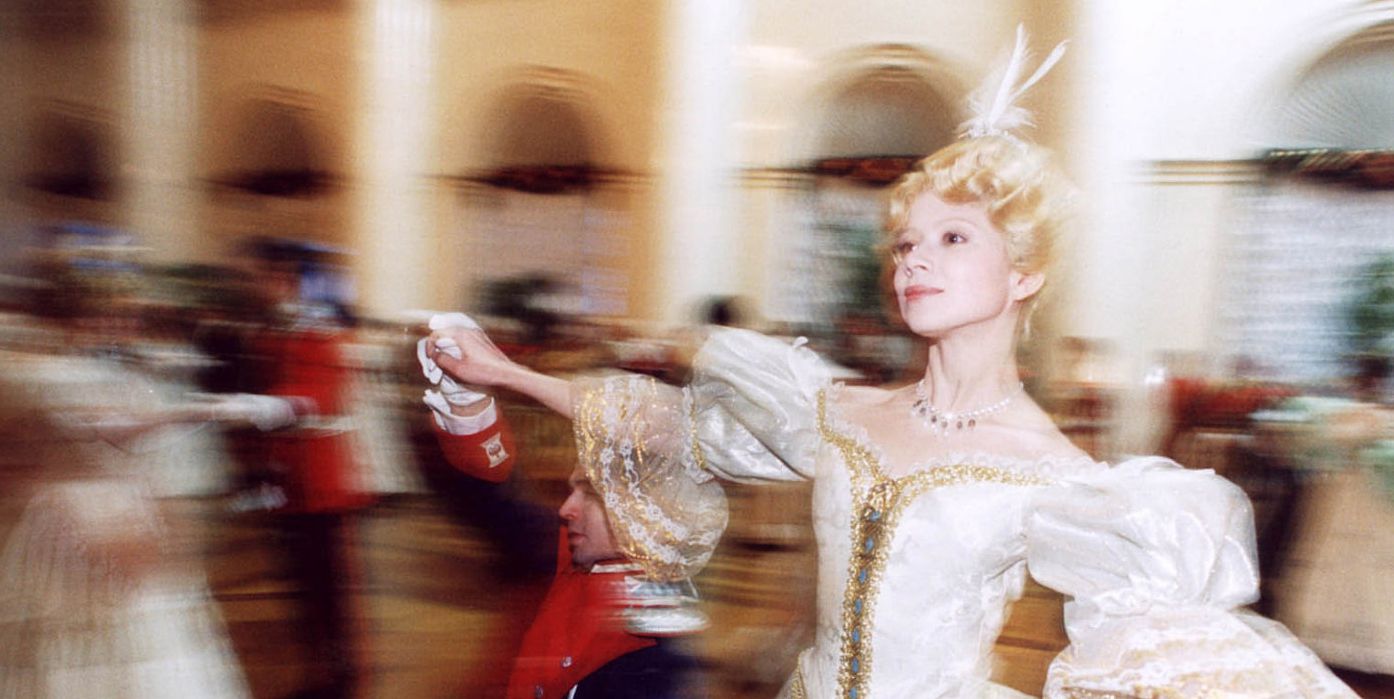
Recognized within the film industry as the first director to create a feature length film in one take, Alexander Sokurov introduced the world to Russian Ark in 2002. Within a nonstop hour and forty minutes, Sokurov weaves the viewer through Saint Petersburg’s Winter Palace. With the expertise of a dressmaker and the harmony of an orchestral conductor, the film manages to exemplify Russian history in an alluring, dynamic masterpiece. According to In One Breath, a documentary on the making of Russian Ark, the film was attempted four times. The first failed within five minutes. After two more failed attempts, they were left with only enough battery power for one final take. The four hours of daylight available were also nearly gone. Fortunately, the final take was a success and the film was completed at 90 minutes. Why did Sokurov go through all this trouble? It certainly would raise issues within the production budget, and in 2002 there were enough modern editing techniques to ease the process. Sokurov chose to use this complicated device because of the emotional impact the single shot would have on the audience. The seamless visual narrative is breathtaking and much more realistic to the human experience in Russia over the course of several eras. Rather than feeling like you are simply watching a film about Russian history, the perception of the single take invites the viewer to step directly into the celestial blur of Sokurov’s world.
The most recent notable achievement in single-take filmmaking was the 2019 Academy Award winning work of Sam Mendes. Alongside his versatile cinematographer Roger Deakins (Skyfall, Fargo, Blade Runner: 2049), Mendes used a variety of devices to follow the onetake narrative structure for his British World War I epic film. Inspired by a story told to the director by his late grandfather, 1917 follows two soldiers as they encroach through enemy territory in order to deliver a life saving message. In the narrow compartments of dirt trenches and on the surface of crumbling cities, 1917 is a highly choreographed, explosively emotional tango. Other than a sensational score and cinematography treatment, the reason this film is so significant is because of how tedious the production process was. During an interview with Vox magazine, Mendes explains that due to the perspective devices used to film the movie, it ended up feeling more like a “ticking clock thriller” than a war movie.
In an extended featurette of 1917, cinematographer Roger Deakins also noted the unexpected element of weather and the factors it played on production, which was done almost entirely in natural light: “I’m looking at all my weather apps to see when it’s going to cloud over, and then is that cloud going to last long enough to a five minute take?” The uncertainty of the weather added a sense of pressure and risk to the entire production, which is clearly expressed in the final cut of the project. Even for those that find war movies a bit uninteresting, it’s difficult to watch 1917 without picking up on the hustling tone of the story. It is important to note that while 1917 was no doubt a miracle of creation and a highly impressive one at that, it did have a few disguised splices; for instance, when lead actor George Mackay’s character loses consciousness for a moment, the screen dips to black and adjustments are made behind the scene before the audience is thrown right back into the warfare.
While both 1917 and Russian Ark are highly synchronised, expensive constructions of cinema, there are also a few less exuberant single take productions. Victoria, for instance – a 2015 German crime thriller by Sebastian Schipper. Unlike his contemporaries Sokurov and Mendes, Schipper allowed for minor script improvisations. The final cut was not exactly what he originally planned for, but that was kind of the point: “The biggest challenge was for the actors to be present, and in the “now” entirely.” explained Schipper in an interview (IndieWire, 2019). Schipper goes on to explain:
“Don’t be afraid of mistakes. It doesn’t matter. You just have to go in (to the cinema) and experience what they go through, all the crazy things, joy, flirting, love, fear, fear for your life, being bored.”
For Schipper, it was difficult to convince studios to help him create his vision – a two hour and twenty minute spotlight on a young Spanish woman as she navigates the Berlin night scene and becomes involved in an illicit bank robbery. We watch and feel the emotions of Laia Costa’s character Victoria play out in real time. The single take is a fascinating choice of tool to illustrate this. On the single take device, Schipper said: “We thought we could do a jumpcut version of this, if it didn’t work out…The material does not work like that. I feel like we are much better than we think at decoding certain situations, you know the flow, or the temperature of the flow…I think you would detect it.” Schipper is correct – critics can pick out ingenuity in a film like a shark finds blood in the water. Having an authentic narrative is one of the hardest things to attain in a film, because it’s not something you can pay for or edit in post. It lives and breathes in the story, from the script to the actors motion. Motion that means nothing if it’s not filmed in the most authentic light. Schipper’s Victoria is perhaps the most relevant example of a single take film that completely immerses its audience.
III. Traversing Through Time
It is important to briefly emphasise the contrast between the one take films mentioned in this essay: Russian Ark, 1917, and Victoria. With vast differences in narrative and production budget, both 1917 and Victoria utilise a chronological structure. Their stories are concise and follow specific characters through a period in time, without moving back and forth. The same can not be said of Russian Ark. Other than being the most notable first attempt at a single take film, Sokurov’s triumph comes from the seamless incorporation of countless eras in Russian history. These eras are shown through a variety of techniques in the costume, set design, and choreography. Sokurov expertly navigates the conventions of tradition and rhythm in order to present a work that is nothing short of magical. There is a quote of fantastical novelist and realist, Franz Kafka, that seems fitting here as this examination comes to a close. It’s short and sweet: “Went to the cinema. Cried.” This incredibly succinct but striking quotation can be applied to contemporary cinema in the idea of authenticity. Even with thousands of cuts and computer generated explosions, (unless the viewer is an 8 year old) it’s difficult to convince an audience of a genuinely worthy film. A movie that made them feel an emotional connection to whatever the character is going through. It is the opinion of many film contemporaries that the way to achieve this transparent relationship with an audience is to give them the singular take perspective.
Grode, Eric. 1917’ Isn’t the First (Supposedly) One-Shot Film. Here’s a Timeline. The New York Times. The New York Times, December 25, 2019.
Hollywood Insider. Video: Come Behind The Scenes of Oscar Worthy & Golden Globes Nominated ‘1917’ With Director Sam Mendes, George MacKay, Dean-Charles Chapman & Team – Hollywood Insider. Dec. 28, 2019.
How ‘1917’ Was Filmed To Look Like One Shot | Movies Insider. YouTube. January 9, 2020.
Images, Photograph by SSPL/Getty, and Photograph by Rue Des Archives/Album. “Lights! Camera! Action! How the Lumière Brothers Invented the Movies.” History Magazine, February 22, 2019.
In One Breath | Alexander Sokurov’s Russian Ark (Making of). YouTube. YouTube, January 19, 2016.
Loiperdinger, Martin, and Bernd Elzer. Lumiere’s Arrival of the Train: Cinema’s Founding Myth. The Moving Image 4, no. 1 (2004): 89-118.
Lattanzio, Ryan. No One Believed Sebastian Schipper Could Make ‘Victoria’ in One Take. IndieWire. IndieWire, June 23, 2016.
VideoIMDb. ‘1917’ Behind-the-Scenes Extended Featurette on One Long Shot. YouTube. December 10, 2019.
War Film a Moral Dilemma : Movies: ‘December 7th’ Was Deemed a Propaganda Failure and Shelved. It Screens Tonight at Saddleback College to Open ‘The Road to War’ Series. Los Angeles Times. Los Angeles Times, December 6, 1991.
Wilkinson, Alissa. Why Sam Mendes Made 1917 Look like It Was Shot in a Single, Continuous Take. Vox. Vox, December 30, 2019.
Zischler, Hanns. Kafka Goes to the Movies. Accessed January 7, 2021.